Thermo-Cognitive Advanced Process Control (TC-APC) models, simulates and optimizes your process in real time to improve yield, conversion and throughput, and reduce energy use, with a quick payback.
Vacuum fractionation of aroma chemicals
How much prime product is in your intermediate cut?
Probably more than anyone thinks. It has nothing to do with the operator's skill and everything to do with the instrument he steers by:
Temperature at the column head.
It moves with pressure as much as it moves with composition. A boiling point cannot tell you which compounds are boiling, only that something is. And it is least trustworthy exactly when it matters most: adjust the reflux to sharpen the cut and the reading takes time to catch up with what the column is actually doing.
The science under TC-APC
Physics first. AI to sharpen it.
TC-APC is built on that science, and AI makes it sharper.

Our Chief Scientific Advisor, Prof. Pratim Biswas, has spent four decades on the science of droplets, particles and flames. Member, US National Academy of Engineering; former Dean of Engineering, University of Miami; Fuchs Memorial Award, the highest honor in aerosol science; over 500 papers and 17 US patents. His record
When the noise from pressure is wider than the transition you are trying to detect, the temperature reading cannot resolve the cut.
The operator is not guessing badly. He is guessing.
That is one instrument, in one industry.
Every process has a boiling point.
Some number that tells you something is happening, and not what. The instrument changes with the industry. The argument does not.
- Dryers, milk and chemical powders Outlet temperature tells you the air is hot. It does not tell you how wet the powder is.
- Aroma and specialty distillation A boiling point tells you something is boiling. It does not tell you what.
- Natural extracts and oleoresins A residual solvent result tells you the extract passed. It does not tell you what it lost to pass.
- Solvent recovery, DMSO and DMF The solvent is back in the tank. How much went to residue, and how much decomposed on the way, appears in no reading.
- IPA and DIPE separation Near the azeotrope the temperature goes flat exactly where the cut point sits. The signal disappears precisely where you need it.
- Sugar crystallization in vacuum pans Supersaturation decides the crystal. In seventy years nobody has measured it online.
- Soda ash carbonation The conversion is known when the analysis comes back. By then the tower has moved on.
- Protein gelation, surimi to crab stick A gel strength grade tells you the paste was strong eight months ago, in another country.
- Boilers and combustion An oxygen reading tells you the excess air is right for the coal you assumed you were burning.
- Reaction selectivity, nitration and Grignard Temperature buys conversion and hazard in the same movement. Nothing tells you which one you have just bought.
- Plant Ledger, the whole plant A log sheet tells you what was made. It does not tell you what was lost.
- Any other process If a number nobody measures decides the money, the argument is the same.
Back to the column
Head temperature is the signal most cut decisions are made on. Under vacuum it is also the signal most affected by pressure. A three millibar drift, a condenser fouling slightly, a gland leaking, a vacuum pump warming through the shift, moves the apparent boiling point by four to six degrees.
Close boiling terpene fractions differ by only a few degrees at atmospheric pressure. The temperature signature of the transition is comparable to, and often smaller than, the noise created by ordinary pressure drift.
So the operator cannot distinguish a change in composition from a change in pressure. In practice he assumes the less favorable explanation and acts on it.
And because cutting late fails loudly while cutting early fails silently, the error runs one way, in almost every plant.
Cut early
Prime product into the intermediate cut. No alarm, no lab report, no shift log.
Cut late
Transition material into the prime fraction. Odor failure, complaint, requalification.
One error is loud and the other is silent. After some years of that feedback, operators converge on the same behavior: cut early, and keep cutting early. It is not carelessness. It is the rational response to asymmetric consequences, and it is why the bias runs in one direction rather than averaging out. It is also straightforward to test. Assay the intermediate cut.
A boiling point tells you something is boiling.
TC-APC tells you what.
TC-APC estimates that composition continuously, and holds the column at the cut point.
Thermo-Cognitive Advanced Process Control runs a full thermodynamic model of your column against live plant data and reports composition on every stream, every few seconds, where before there was a head temperature and a laboratory result every half hour.
It is an estimate, and the screen says so. The current figure, the last gas chromatograph result beside it, and the running bias between the two. Exactness is something you would have to take on trust. This you check against your own GC, every shift, on every batch.
What it estimates
Composition on every stream, inferred from the instruments the column already has. No new analyzer, no sample system, no online chromatograph to buy, install and keep calibrated.
What it displays
The live figure, the last GC result beside it, the running bias between the two, and the reason for every setpoint it has just moved. Every move is logged with the model state that produced it.
What checks it
Your gas chromatograph, every time it reports. TC-APC interpolates between GC results and holds the column steady in between. The GC remains the reference and the arbiter.
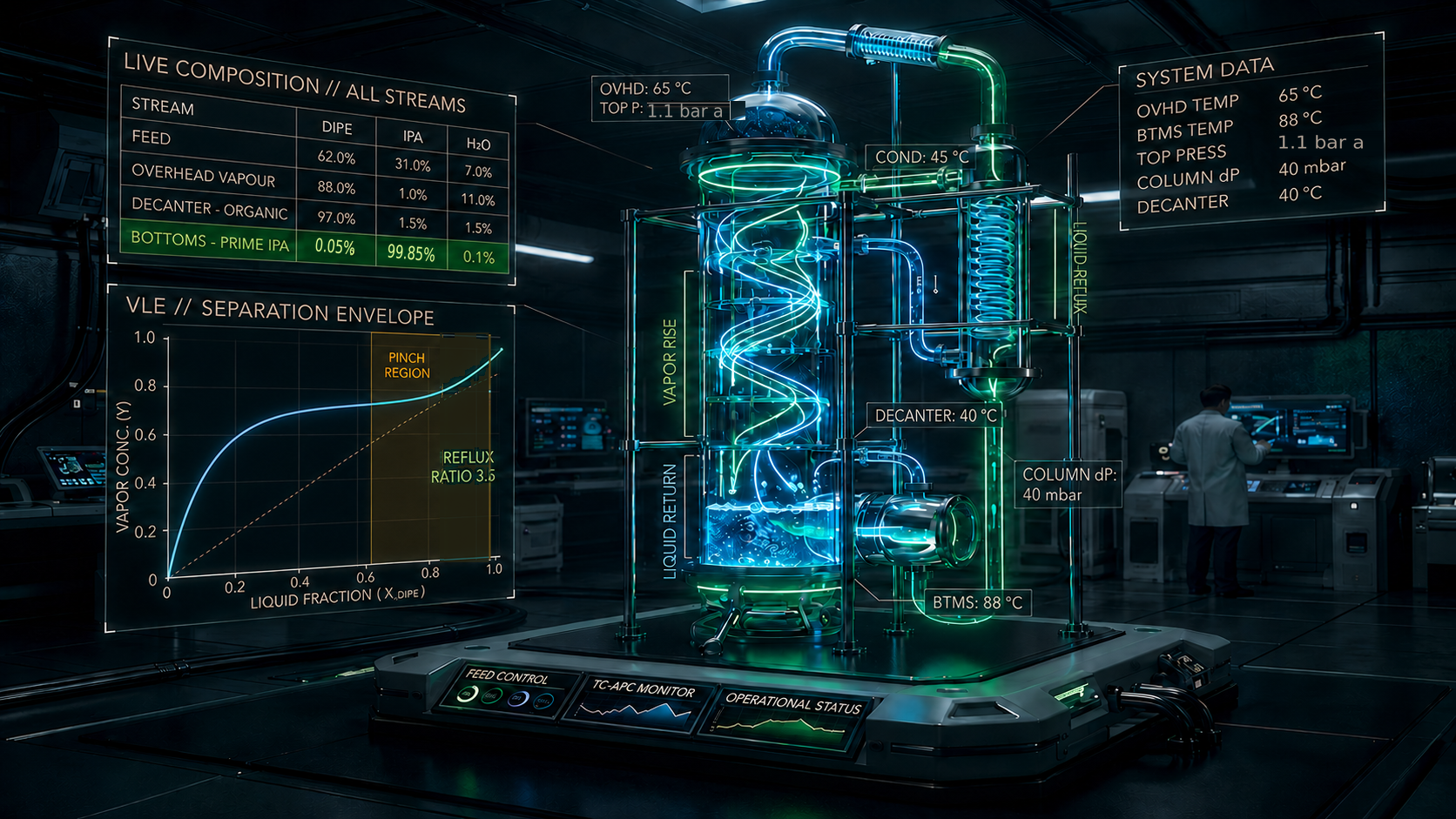
What the engine sees, drawn as if the column were transparent. Representative column, indicative values. The panels show live composition on feed, overhead, decanter and bottoms, the separation envelope with the pinch region marked, and the column's operating temperatures, pressure and differential pressure.
Track record
Deployed, named, and checkable.
Our deployment
Deployed and validated
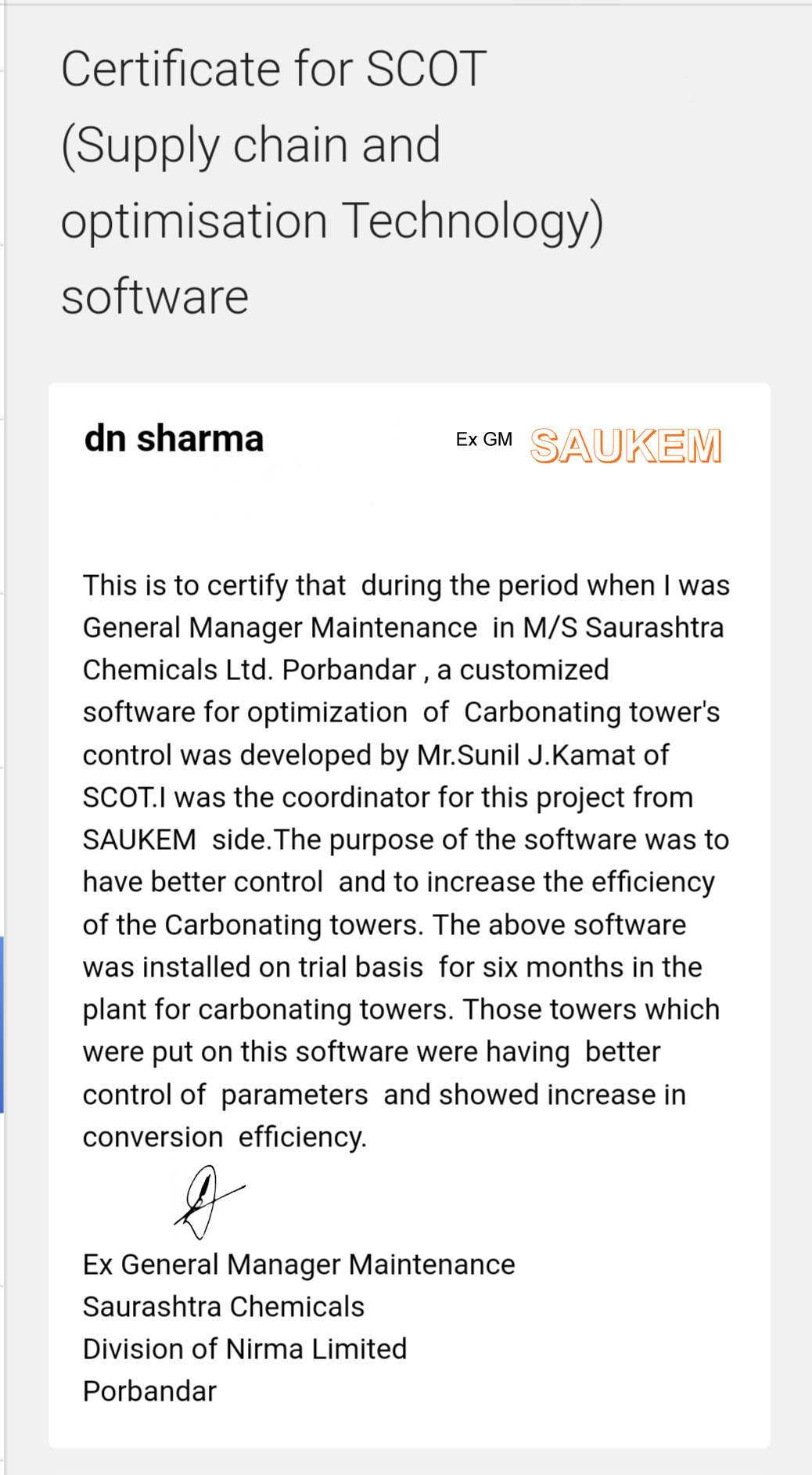
Fourteen carbonation towers at Saurashtra Chemicals, a division of Nirma Ltd, Porbandar. A hybrid thermodynamic, kinetic and physical model, solving over three hundred simultaneous equations in real time against live plant data, reading the towers through the existing control system and issuing setpoints back to it. Validated over six months of plant operation.
Those towers which were put on this software were having better control of parameters and showed increase in conversion efficiency.

D. N. Sharma Then General Manager Maintenance, Saurashtra Chemicals, a division of Nirma Limited, Porbandar. He coordinated the project and will take a reference call.
The work was carried out under an earlier company name, which appears on the certificate.
Our Chief Scientific Advisor's industrial record
855 MW
Paint to Power, with Chrysler and Ameren
Chrysler's St. Louis plants sent their paint solids to Ameren's 855 MW Meramec power plant, where they replaced about 570 tons of coal a year. Prof. Biswas led the project to capture mercury with the titanium dioxide in those solids. 2007 Chrysler Environmental Leadership Award.
98.9%
Fine particles captured at a steel smelter
A pulse-energized electrostatic precipitator, tested on an iron and steel smelter's exhaust, captured over 98.9% of particles from 0.16 to 6.7 µm by number.
17
US patents
Including capture of heavy-metal emissions from combustion exhaust, electrostatic capture of fine particles, and aerosol sensing.
What arrives on site
A supervisory layer, and the hardware that runs it.

- SystemIndustrial fanless unit, rack or panel mounted, running the thermodynamic model and the optimizer.
- Operator HMIField panel showing the live estimate, the last lab result, the current bias and the reason for every move.
- InterfaceOPC‑UA or Modbus to your existing DCS, PLC or single loop controller (SLC). Reads process variables, writes setpoints. No change to your control system.
- GuardrailsHeartbeat watchdog and rate‑of‑change limits held in the DCS block. On any timeout, implausible estimate or out‑of‑range output, control reverts to the DCS with bumpless transfer to predefined fallback setpoints.
- EngineeringBuilt-in engines, customized and tuned offsite against a simulator matched to your column, commissioned on site, and validated in shadow mode before it writes setpoints.
- What stays yoursThe validated model remains useful for debottlenecking, operator training, what‑if studies and turnaround planning, whether or not TC-APC is writing.
Where it sits
TC-APC sits above the control system you already have. It reads process variables from it and writes setpoints back to it. The loop between your DCS and your plant is untouched, and the guardrails that hand control back to the DCS live inside the DCS rather than inside our box.
How it is deployed
It writes setpoints only after you have watched it be right.
01
Tuned offsite
The engines are built in. Before the system arrives on site, they are customized and tuned against a simulator matched to your column. Nothing is connected to your plant during this stage.
02
Shadow mode
On site, reading live plant data across multiple batches or operating cycles, writing nothing back. You compare its estimate against your own laboratory results for as long as you want to.
03
Validated against your laboratory
Live writing is enabled only after the estimate tracks your GC results inside an agreed tolerance band. You set the tolerance, and you decide when it has been met.
04
Clamped increments
Setpoints move in small steps inside limits held in your DCS. Your operators watch every move and the reason given for it. The fallback is always the system you are running today.
Who this is
An engineering group of IIT Bombay alumni.
Chief Scientific Advisor
Prof. Pratim Biswas
Member, US National Academy of Engineering; former Dean of Engineering, University of Miami.
 Chief Strategy Advisor
Prof. Janat Shah
Founding Director, IIM Udaipur; for two decades Professor of Operations Management, IIM Bangalore.
The engines behind TC-APC were built within the group, and the group customizes and tunes them to each process it takes on.
Among its associates are Madhav Dhekane, Fellow of the Indian National Academy of Engineering, who designed control systems for ISRO's launch vehicles; Sunil Mehta, named inventor on 92 US patents; and Dr. Makarand Phadke, Senior Vice President of Innovation at Reliance Industries for 13 years.
Published in Chemical Weekly, October 2025, on combining process knowledge with artificial intelligence to optimize chemical manufacturing.
The mark
Find the optimum. Hold it while it moves.
The curve is a yield or selectivity response. The amber point is the optimum, and the dashed drop is where it sits on the operating axis.
The second half of the line is the part that matters. Finding an optimum is a study, and studies end up in drawers. Holding one while the feed, the fouling, the weather and the wear keep moving it is a control problem, and that is the work.
Start with the note
Cut-point determination in the vacuum fractionation of odour-critical products
Three pages on the measurement problem and what can be inferred without new analyzers. Free, and nothing to sit through. No form, and we do not ask for your email address.
Or start with your column
Send three months of operating data from one column
We will tell you what your transition cut is costing you, with the uncertainty stated openly rather than buried. No charge, and no commitment either way. Including the answer that there is nothing here worth pursuing, if that is what your numbers say.
projects@yielddynamics.in Talk to IIT Bombay engineers Call +91 94230 07004Monday to Saturday, 9:00 to 19:00 IST