Thermo-Cognitive Advanced Process Control (TC-APC) models, simulates and optimizes your process in real time to improve yield, conversion and throughput, and reduce energy use, with a quick payback.
Spray dryers: milk, food and chemical powders
Outlet temperature tells you the air is hot. It does not tell you how wet the powder is.
So every dryer is run drier than its limit, to be safe.
You pay twice: in fuel, and in powder you could have sold.
The science under TC-APC
A dryer's result is decided in the droplet.
A powder's moisture, density and particle size are set in the droplet, in seconds. That's the science TC-APC is built on, and AI makes it sharper.

This is the field of our Chief Scientific Advisor, Prof. Pratim Biswas, Member, US National Academy of Engineering and former Dean of Engineering, University of Miami. His published work includes:
- Porous particles made by spray drying. Advanced Materials, 2007
- Predicting the size and charge of particles formed as droplets evaporate. Chemical Engineering Science, 2021
- A model of particle-laden gas flows with strong heat and mass transfer between the gas and the particles. Computers & Fluids, 2006
- Four kinds of particle-population model compared for aerosol dynamics. Aerosol Science and Technology, 2020
Part 1. Milk and food powders
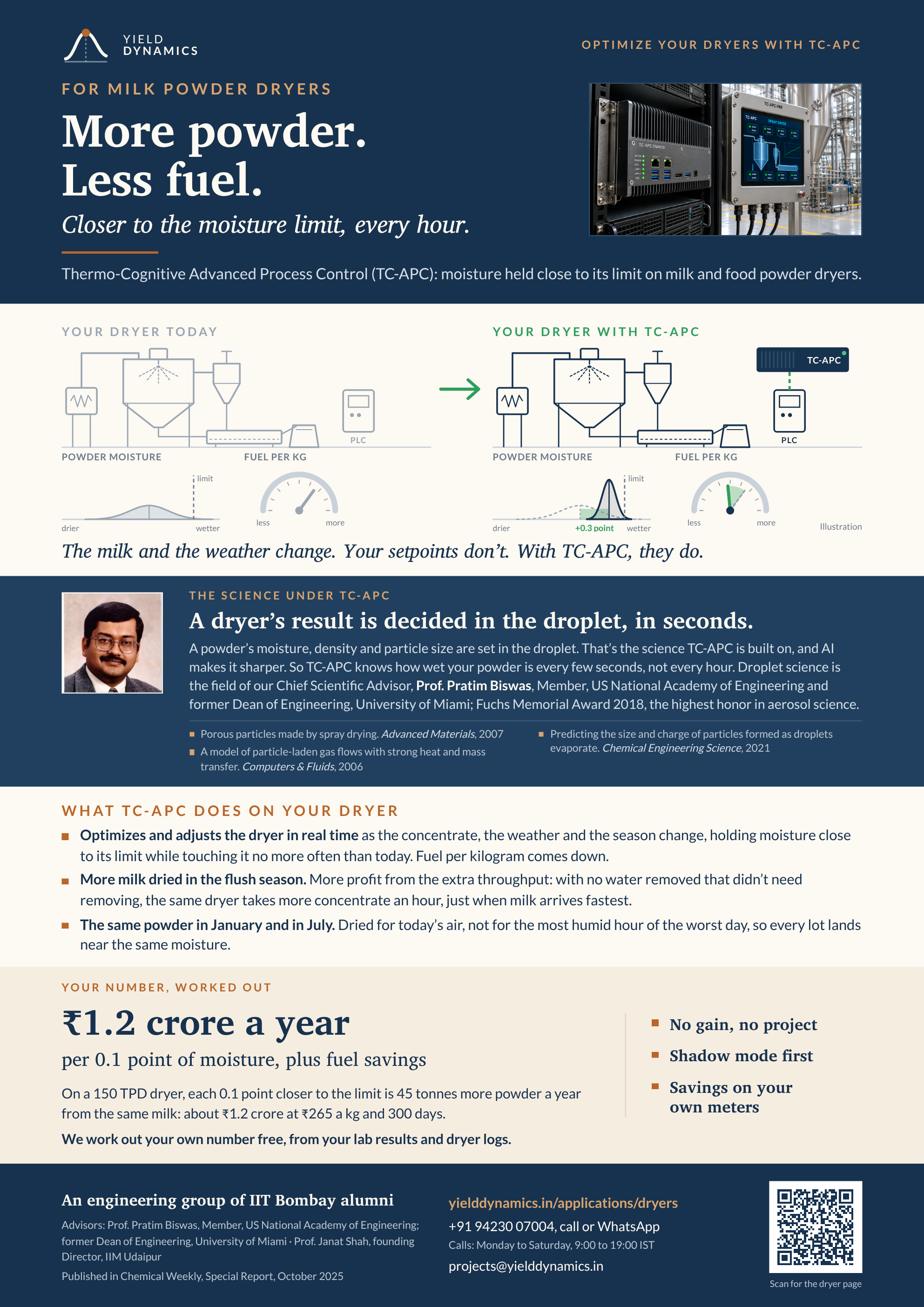
Every 0.1 point of moisture kept below the limit is water you could have sold at the price of powder.
Skim and whole milk powder, dairy whitener, whey and food powders are dried on outlet air temperature, set from experience. The real moisture is known only when the lab result comes back, so the dryer is run well inside the limit, every hour, to cover the hour nobody saw.
Both curves touch the limit equally often, so neither makes more off-spec powder than the other. The narrow one simply sells more water at the price of powder.
On a 150 TPD dryer, every 0.1 point is about ₹1.2 crore a year, before the fuel saved is counted.
Where a milk powder dryer loses money today.
None of this is anyone's fault. Every one of these is visible in three months of your own lab results and dryer logs, which is why that is the first thing we ask for.
01
Dried for the worst hour
The outlet temperature is set for the most humid hour of the worst day, and then left there. Every other hour dries the powder further than it needs.
02
The lab answers an hour late
By the time a moisture result comes back, the dryer has made another tonne or more. The margin has to cover whatever happened in between, so it is kept wide.
03
The weather moves the powder
Air humidity changes through the day and the season. The same outlet temperature gives a different moisture in January and in July, and nothing in the loop sees it coming.
04
The concentrate is never the same
Solids, temperature and thickness of the feed move with the milk, the season and the evaporator. The dryer finds out only after the powder has changed.
05
The flush season bottleneck
When milk arrives faster than the dryer can take it, every unnecessary degree of drying is output you cannot make, and milk you must hold, divert or sell cheaper.
06
Fuel spent removing water you could have sold
Water taken out below the limit is paid for twice: once in steam or fuel to remove it, and once in powder weight you no longer have to sell.
TC-APC knows how wet the powder is. Every few seconds, not every hour.
What 0.1 point of moisture is worth, every year.
Each 0.1 point held closer to the limit is about 0.1% more powder from the same milk solids. At 300 days a year and ₹265 a kg:
30 TPD dryer
₹24 lakh
a year, for each 0.1 point
60 TPD dryer
₹48 lakh
a year, for each 0.1 point
100 TPD dryer
₹80 lakh
a year, for each 0.1 point
150 TPD dryer
₹1.2 crore
a year, for each 0.1 point
The fuel saved, the extra output in the flush season, and a thicker concentrate that leaves the dryer less water to remove all come on top of this.
The one-page flyer
TC-APC for milk powder dryers
Click to read it full size.Tap to open it.
Part 2. Chemical powders
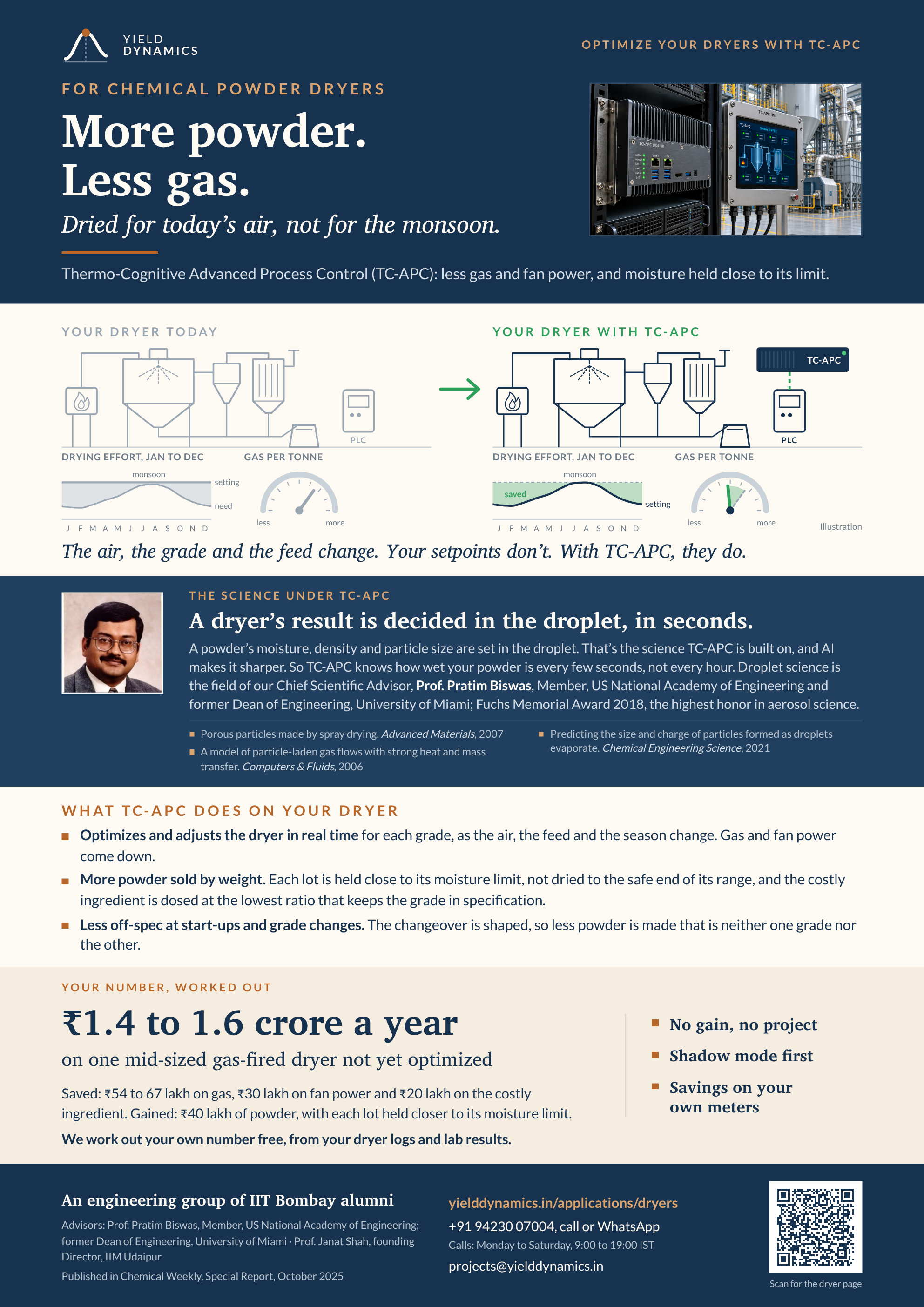
A setting chosen for the monsoon, and run all year.
If your dryer makes many grades, blends a costly solution into its feed, burns gas, and sells its powder by weight against a strength range, this part is about your dryer. Each of those is a place where a safe setting was chosen once, for the worst case, and has been paid for every day since.
The setting was chosen in a humid month, so that no lot would ever leave too wet. For most of the year the air is drier than that, and the dryer works harder than the powder needs.
Nothing in the loop is watching the need move, so the margin is paid for every hour of the dry season.
Where a chemical powder dryer loses money today.
Again, nobody is doing anything wrong. A safe setting is the rational choice when nothing tells you how close to the edge you are.
01
One safe setting for every grade
Each grade has its own best outlet temperature, air flow and feed rate. In practice a few safe settings cover all of them, and the safest one wins.
02
The costly ingredient, dosed with room to spare
Where two solutions are blended, the costly one is dosed toward the top of its range so that no lot ever falls short. That excess is bought for every batch.
03
Lots dried to the safe end of their range
Powder sold by weight against a strength range is dried toward the drier, stronger end of it. Every tenth of a point more than the lot needs is product given away by weight.
04
Off-spec at start-ups and grade changes
Each start-up and each change of grade makes powder that is neither one grade nor the other. It is reworked, blended away or sold cheaper.
05
Uneven powder, uneven milling
Moisture that wanders mills unevenly: the wetter part clogs, the drier part dusts. More goes round again as fines, and fine grades take longer to make.
06
Gas and fan power
The burner and the fans are set for the monsoon and left there. Through the dry months they heat and move air the powder never needed.
With TC-APC, each grade is dried for today's air, not for the monsoon.
A worked example: one gas-fired dryer, not yet optimized.
Round numbers for a mid-sized chemical spray dryer. Yours will be different, which is what the free audit is for.
| Where the money is | On what | ₹ a year |
|---|---|---|
| Gas | 8 to 10% of a ₹6.7 crore gas bill: 100 scm an hour, 8,000 hours, ₹84 a scm | ₹54 to 67 lakh |
| Fan power | About a third of a ₹90 lakh fan bill: 150 kW, 8,000 hours, ₹7.5 a unit, with speed drives on the fans | ₹30 lakh |
| The costly ingredient | 1% less of a solution bought for ₹20 crore a year, every grade still in specification | ₹20 lakh |
| The strength range | 0.1 point closer to the lower limit, on ₹100 crore of powder sold by weight at 25% strength | ₹40 lakh |
| One dryer, a year | ₹1.4 to 1.6 crore |
A plant with three such dryers: about ₹4 to 5 crore a year. On a dryer that has already been optimized, the gas and fan figures will be smaller, and the free audit says by how much.
Every rupee figure on this page is a worked example on stated assumptions, listed at the foot of the page. The free audit replaces each one with a figure from your own records.
The one-page flyer
TC-APC for chemical powder dryers
Click to read it full size.Tap to open it.
What TC-APC adds
A layer above the controls you already have, made for dryers.
It does not replace your DCS, PLC, SLC or burner management, and it does not touch your interlocks, trips or fire protection. It sits above them, works out what the dryer should be doing for the powder in it today, and writes setpoints down.
| Today | With TC-APC | |
|---|---|---|
| Powder moisture | Known when the lab answers, an hour later | Estimated every few seconds, and checked against every lab result |
| The moisture target | Set well inside the limit, for the worst hour | Held close to the limit, through weather and feed changes |
| Strength, for powder sold by weight | Dried to the safe end of the range | Held where the range allows, lot after lot |
| Outlet temperature | A fixed number, from experience | Re-derived continuously for today's air, feed and grade |
| Output | Whatever the safe setting allows | Pushed to the dryer's real limits when the product is wanted |
| Gas, steam and fans | Set for the monsoon, run all year | Trimmed to what drying needs today |
| The costly ingredient | Dosed with room to spare | Held at the lowest ratio that keeps the grade in specification |
| Concentrate, for milk | Solids held to a fixed target | As thick as the atomizer can take today |
| Start-ups and grade changes | Off-spec until the dryer settles | Shaped, so less powder is made out of specification |
Everything it does, in four parts.
It knows
- Powder moisture, every few seconds, from signals your dryer already has
- Strength between lab samples, for powder sold against a range
- What the air can carry today: temperature and humidity, now and as forecast
- The feed: solids, temperature and thickness, as they change
- How close each product is to its own limits
It acts
- Holds moisture or strength at a target closer to the limit
- Pushes output to the dryer's real limits when the product is wanted
- When more output is not needed, trims gas, steam and fan power instead
- Moves inlet and outlet temperatures, feed and air flow together
- Sets evaporator solids, the blend ratio and the chiller for today
- Shapes start-ups and grade changes
It protects
- Moves only inside a range your team signs off, in small steps
- Keeps each product clear of sticking, scorching and softening
- Leaves interlocks, trips, fire and explosion protection untouched
- Falls back to your own setpoints, bumplessly, on any fault
- Stops the moment your operator switches it off
It reports
- Live moisture or strength beside every lab result
- Rupees each shift: powder gained, gas and power saved
- Early warning of wall deposits, nozzle wear and drifting instruments
- A complete drying record for every lot
- Every setpoint move, logged and time-stamped
Features and modules
Twelve modules, one system, built around the dryer.
Each one is made for spray dryers, from milk and food powders to chemicals, and all of them work together above the controls you already have.
Milk and chemical
Output and energy
Pushes output to the dryer's real limits when the product is wanted. When more output is not needed, trims gas, steam and fan power instead.
Milk
Concentrate
Solids taken up to what the atomizer can take today, so more water leaves in the evaporator, where it costs far less to remove than in the dryer.
Chemical
Costly ingredient
The blend ratio trimmed to the lowest that keeps each grade in specification.
Milk and chemical
Product limits that move
Sticking, scorching and softening, held as the conditions that cause them change, so the moisture target can sit closer without the powder sticking.
Milk and chemical
Monsoon
The chiller or dehumidifier set from what drying needs today, not for the worst monsoon day, with the weather forecast fed in ahead of a humid spell.
Milk and chemical
Start-ups and restarts
Start-ups, and restarts after a power trip or a switch to the diesel generator, brought to prime powder sooner, with less to rework.
Milk and chemical
Grade changes
A few numbers per grade, a cautious mode for a new one, and each change of grade shaped so less powder is made that is neither one grade nor the other.
Milk and chemical
Deposits, cleaning and fire risk
Cleaning brought forward or put off to match the chamber, and early warning of wall deposits, nozzle wear and the conditions in which deposits start to smolder. It does not replace your CO detection or fire protection.
Milk and chemical
Heat source
The dryer and its boiler or thermic fluid heater run as one, so a dip in steam or heat is met before it reaches the powder.
Milk and food
Bulk density, where your lab measures it
Bulk density decides the fill weight of a tin or bag and how the powder flows, and customers specify it. It is set mostly by the concentrate, the atomizer, the drying temperatures and the fine powder returned to the dryer. Where your lab measures it regularly and the dryer has room to move those, this module holds it closer to target. How close depends on your dryer; the free audit tells you before you decide.
Milk and chemical
Several dryers, one plan
Which dryer should make which grade, and how fast, based on what each costs per tonne today. Give it your orders and the margin on each grade, and it works out the production plan that earns the most from the dryers you have. The best-paying grades go to the dryers that make them cheapest, rush orders go where they cost least, and the plan is worked out again whenever orders, prices or a dryer's condition change.
Milk and chemical
Energy and CO₂, lot by lot
Energy and CO₂ per tonne for every lot, with a complete drying record, ready for your sustainability report and your customers' questions.
Compared with general-purpose APC
Made for dryers, not configured for them.
General-purpose APC packages are capable tools, built to control any process and fitted to yours by the vendor's engineers. TC-APC is built for one kind of equipment at a time, which is why everything it does below comes as standard rather than as extra engineering.
| A general-purpose APC package | TC-APC | |
|---|---|---|
| Where it starts | A model built for each plant by the vendor's engineers | The physics of drying air and powder moisture, built in before it sees your plant |
| How it learns your dryer | Usually from step tests: the dryer is moved on purpose, for days or weeks, while product is being made | From your lab records and normal running, with no campaign of deliberate upsets |
| How it starts | A purchase order, a license and an engineering project | A free audit of your own records, and results judged on your own lab and meters |
| Product limits | Entered as fixed numbers on each variable | Sticking, scorching and softening, held as the conditions that cause them change |
| Humid months | Corrects for the humidity it measures; the chiller runs on its own setting | Sets the chiller from what drying needs today, and acts on the weather forecast before a humid spell arrives |
| Start-ups and restarts | Usually switched in once the dryer is steady | Takes the dryer through start-ups, and restarts after a power trip or a switch to the diesel generator, to prime powder sooner |
| Deposits and fire risk | Outside the usual scope | Early warning of wall deposits, nozzle wear and the conditions in which deposits start to smolder; cleaning when the chamber needs it |
| Several dryers | Each dryer controlled on its own | Which dryer makes which grade, and how fast, based on what each costs per tonne today |
| The money | Controller performance figures | Rupees each shift, and a monthly savings statement against your own baseline |
| Energy and CO₂ | Outside the usual scope | Energy and CO₂ per tonne for every lot, with a complete drying record |
What you get
Every benefit: the ones you can count, and the ones you will notice.
Tangible, in rupees
- More saleable powder from the same milk solids or the same chemistry
- More output from the same dryer in the flush season or when orders are waiting, and an expansion that can wait too
- Less gas or steam for every tonne of powder
- Less fan and chiller power
- A thicker concentrate, so more water leaves in the evaporator, where it costs far less to remove than in the dryer
- Less of the costly ingredient in every grade
- Fewer off-spec lots at start-ups and grade changes
- Less rework, and fewer rejected or downgraded lots
- Fewer fines going round again
- Even milling of the fine grades
- Fewer trips and restarts
- Cleaning when the dryer needs it, not by the calendar
- Less adjusting by hand through every shift
Intangible, and just as real
- Lot-to-lot consistency your customers and auditors can see
- Shelf life you can predict, because no lot leaves wetter than it should
- The night shift runs like the day shift
- Your best operator's judgment, kept in the system rather than in one person's head
- Early warnings instead of findings at the next shutdown
- New grades brought up faster, with less waste
- Production you can plan, because output stops following the weather
- Lower CO₂ for every tonne, for your own reporting and your customers'
- Fewer excursions toward sticking and scorching
- A complete drying record for every lot, for audits and complaints
What arrives on site
A system, wired in beside the one you have.

- ReadsInlet and outlet air temperatures, feed rate, solids and temperature, air flow or fan speeds, chamber pressure, fluid bed temperatures, ambient temperature and humidity, gas or steam meters, and your lab results. Over Modbus or OPC‑UA from your existing DCS, PLC or SLC.
- WritesOutlet and inlet temperature, feed rate and air flow setpoints, and where fitted the evaporator, blend ratio and chiller setpoints, back to the same system. Interlocks, trips and fire protection are untouched.
- Runs separatelyOn its own machine alongside your controls, so nothing in the existing logic is modified. Minimal wiring and no shutdown to install.
- GuardrailsHeartbeat watchdog and rate‑of‑change limits held in your own system. On any timeout or implausible estimate, control reverts with bumpless transfer to your existing setpoints.
- Before it writesRun in shadow mode on your live dryer, writing nothing, until its moisture estimate tracks your lab, for as long as you want to watch it.
- On and offA switch on your operator screen. Off means the dryer runs exactly as it does today, on its own settings.
What this cannot do.
It cannot dry past the dryer's design
Air heater, chamber, fans and atomizer are what they are. Running closer to the real limits is not the same as raising them.
It does not replace your lab
The estimate is checked against your own lab results, so sampling carries on as it does today. What changes is that nobody has to wait for the result to act.
It cannot fix bad instrumentation
If the feed solids meter or an air temperature reads wrong, the estimate inherits that. It will usually tell you the instrument disagrees with the physics, which is the useful part.
It does not touch safety
Interlocks, trips, fire and explosion protection stay exactly as they are, under their own logic, and the supervisory layer writes nothing into them.
The mark
Find the optimum. Hold it while it moves.
The curve is a yield or selectivity response. The amber point is the optimum, and the dashed drop is where it sits on the operating axis.
The second half of the line is the part that matters. Finding an optimum is a study, and studies end up in drawers. Holding one while the feed, the fouling, the weather and the wear keep moving it is a control problem, and that is the work.
Start with a free audit
Send three months of records from one dryer
Lab moisture or strength results with their sample times, and the dryer's logs for the same period. We will tell you how far inside the limit you are running, how much of that the weather and the feed explain, and what closing it is worth in rupees, with the uncertainty stated openly. No charge, no visit, and nothing on your plant changes.
projects@yielddynamics.in Talk to IIT Bombay engineers Call +91 94230 07004Monday to Saturday, 9:00 to 19:00 IST
Or look at what we have actually run
Fourteen carbonation towers, validated over six months
The one deployment we own is named, with the signed letter and the General Manager who still takes reference calls.
Assumptions behind the figures on this page
- Powder is taken as sold per kilogram of total product weight, within its specification. Where a contract pays on active content instead, the strength figures do not apply; the gas, fan and ingredient figures still do.
- Extra powder is taken as sold at the same price. Where it cannot be, the same gain shows up as less milk solids or raw material used for the same output.
- Milk powder: 300 days a year at the stated output, at ₹265 a kg. Each 0.1 point of moisture is taken as 0.1% more powder; the exact figure is slightly higher.
- Chemical dryer: 8,000 running hours a year, natural gas at ₹84 a scm and power at ₹7.5 a unit. The fan figure assumes speed drives on the fans.
- These are worked examples, not any company's data. The free audit replaces every one of them with your own.