Thermo-Cognitive Advanced Process Control (TC-APC) models, simulates and optimizes your process in real time to improve yield, conversion and throughput, and reduce energy use, with a quick payback.
Isopropanol and DIPE, propylene direct hydration
Near the pinch, the temperature goes quiet. The composition does not.
Your column is holding a separation whose signal disappears over precisely the range that decides the product.
So the margin goes up, and stays up.
What this page is based on
The column arrangement and operating values described here are representative of a typical DIPE and IPA separation in a propylene direct-hydration plant. No plant's operating data has been used.
The control problem, composition inferred from a temperature signal that goes flat near the azeotropic pinch, is a property of the DIPE, water and isopropanol system itself rather than of any particular configuration. Yours will differ in the numbers and not in the mechanism.
Engineering proposal. Begins with a data audit on your own column.
The science under TC-APC
A column's result is decided in the vapor and the liquid.
Which compounds leave at the head, and when, is settled between the vapor and the liquid on every tray, not by the temperature read at the top. That's the science TC-APC is built on, and AI makes it sharper.
The blind spot
A real shift in composition produces almost no change in column temperature.
DIPE, water and isopropanol show strongly non-linear activity coefficients under variable feed loads. Approaching the azeotropic region, relative volatility falls away. The separation is still changing. The instrument reporting it is not.
Single input loops then track that flattened signal late, because a temperature reports the vapor arriving now, which reflects tray compositions established some minutes earlier. During a transition, when composition moves fastest, the indication lags most.
So the control gap is not a tuning problem. There is no setting of a loop that recovers information the measurement does not contain.
What the plant does instead is hold high steady-state internal traffic, reflux and boil-up together, wide enough that the separation is safe even when the signal is telling you nothing. That margin narrows the usable operating envelope and it is paid for in steam, every hour, whether the column needs it or not.
Anatomy of the loss
Four steps, and the last one is the expensive one.
01
Upstream volatility
Shifts in reactor conversion alter feed flow rate and incoming composition. The column is asked a different question without being told.
02
Utility shocks
Pressure drops in the main steam header push the DCS steam valve into repeated hunting, which is a disturbance the column did not generate and cannot see the cause of.
03
Entrainment
Those uncoordinated thermal and pressure shifts generate localized, high velocity vapor waves through the column internals.
04
Over-correction
To keep DIPE out of the bottoms, operators raise internal traffic. Prime IPA is carried overhead with it, into the recovery loop, and round it goes again.
Let DIPE into the bottoms
Off-spec product. A laboratory result, a held batch, a conversation. Everyone knows it happened.
Raise traffic to prevent it
Prime IPA overhead, extra stripping duty, extra reprocessing load. It appears in no alarm and no laboratory report.
One failure is loud and the other is silent, so the error runs one way. It is the same asymmetry that puts prime product into the intermediate cut on a batch column, arriving here from a different direction. The batch version of the same argument.
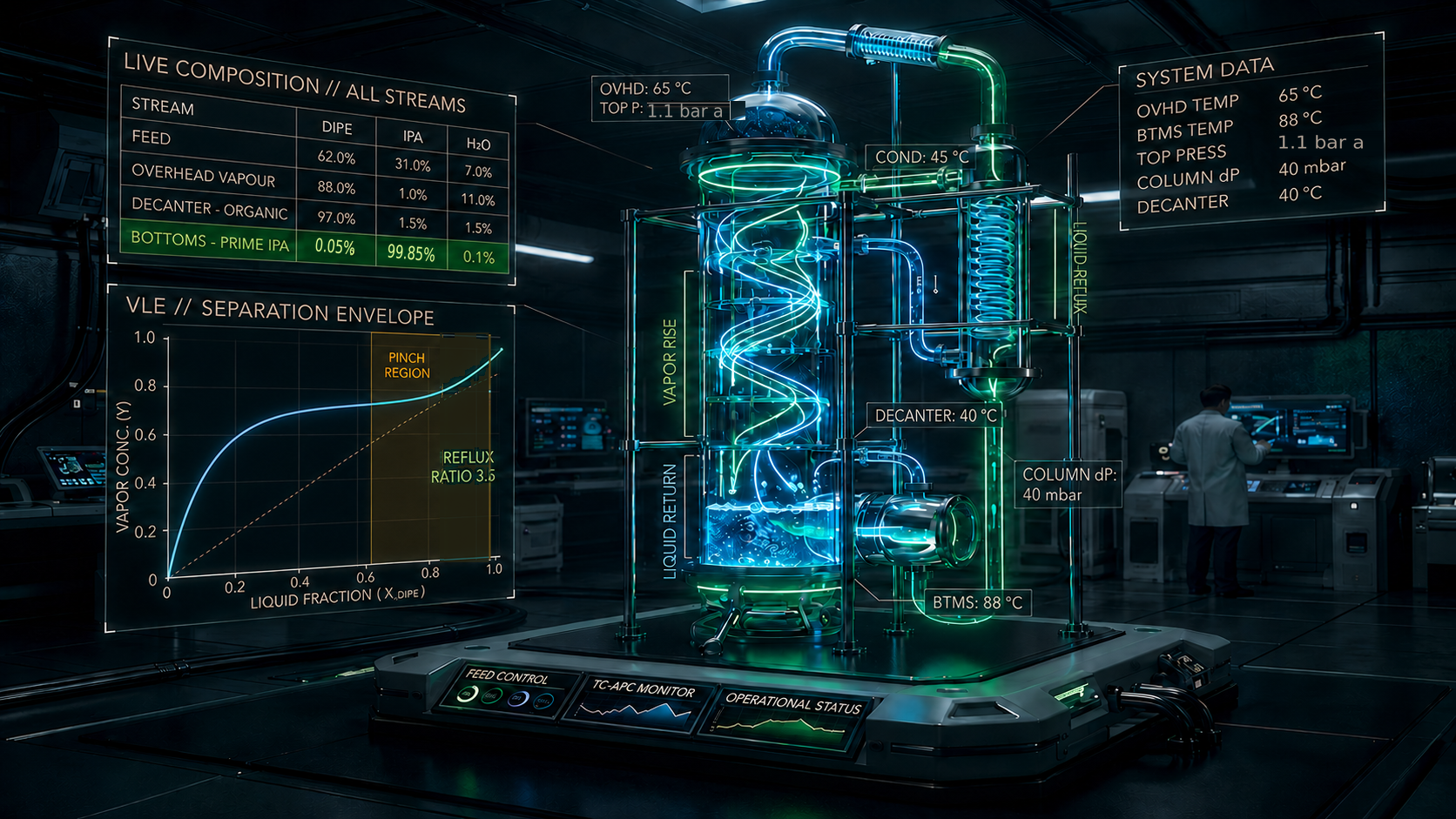
What the engine sees, drawn as if the column were transparent. Representative column, indicative values. The panels show DIPE, IPA and water on every stream, the separation envelope with the pinch region marked, and the column's operating temperatures, pressure and differential pressure.
What TC-APC does about it
It gives the control system a composition to hold.
Your DCS holds temperature, pressure and flow precisely, which is what regulatory control is built to do. It has no composition to hold, because nothing in the loop measures composition.
Continuous inferred purity
On both product streams, so the overhead and the bottoms are each being held to something rather than one being protected at the other's expense.
Differential pressure as the real limit
Column dP is tracked as a direct measure of vapor loading and flooding margin, and that physical limit is what TC-APC respects.
Reflux and steam moved together
Coordinated in real time to absorb upstream disturbances rather than answer each one separately after it has already arrived.
Traffic held to what the separation asks
Internal traffic sized to the current condition of the column rather than to the worst case it might meet, with IPA carryover to the overhead minimized as a result.
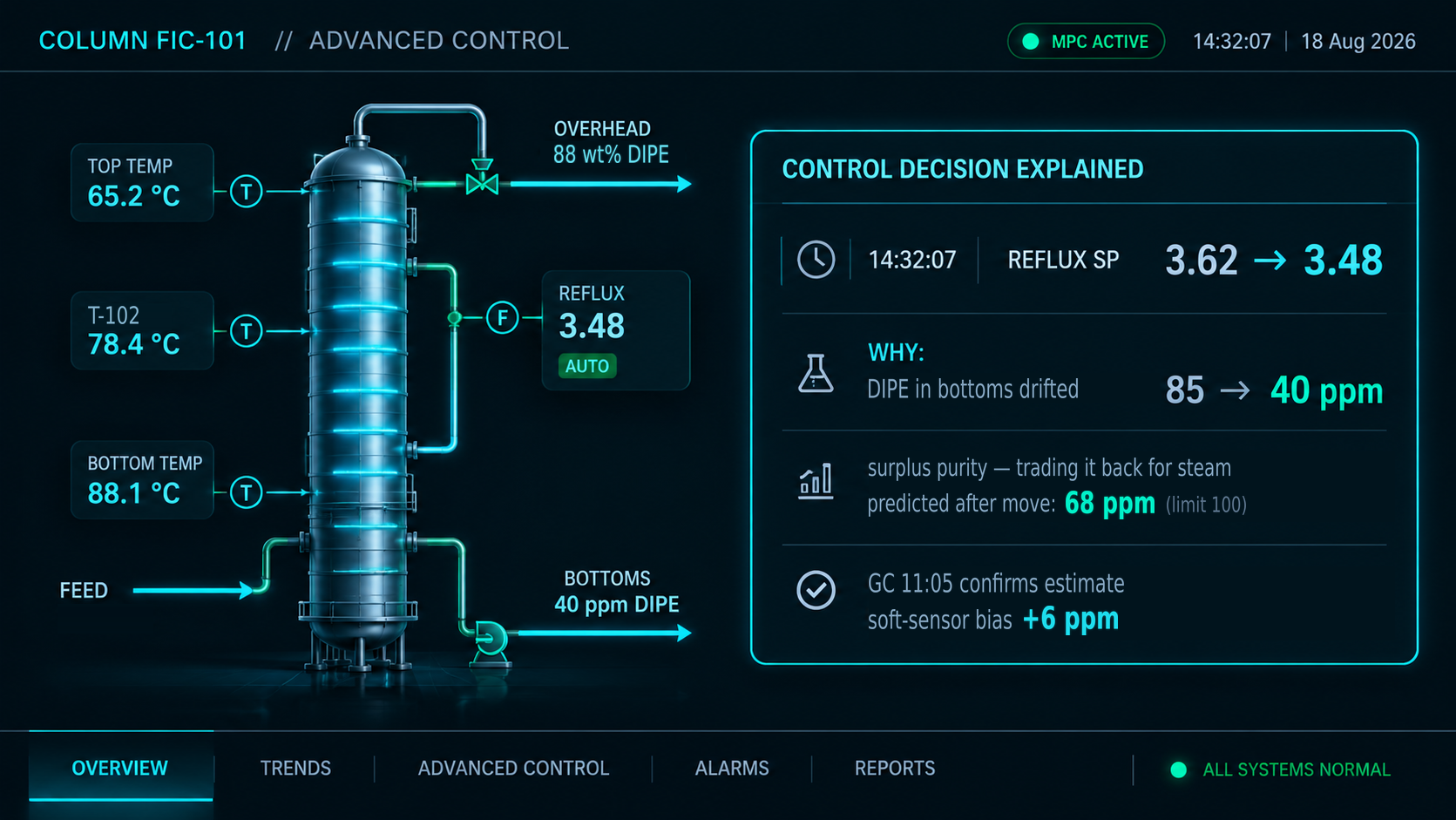
Every move, with the reason that produced it, and its own error beside it. Illustrative screen. The reflux setpoint moves, the reason is given, the predicted result is shown against the limit, and the last GC result is displayed with the current soft sensor bias.
The black box question
You should be able to audit it after the fact, not just watch it in the moment.
The trajectory is visible
The dashboard shows operators and engineers the live concentration trajectory the engine is working from, not just its output.
Every move is explained
Each reflux and steam change is displayed alongside the reasoning that produced it, in the terms your engineers already use.
Every move is logged
Recorded with the model state that produced it, reviewable weeks later when somebody asks why the column did what it did on a Tuesday.
What it protects
Both sides of the separation, and the steam bill.
Yield and co-product
Reduced entrainment keeps saleable IPA in the bottoms rather than sending it round the recovery loop, which cuts stripping duty and reprocessing load at the same time. Cleaner phase separation supports the purity of a co-product the plant has deliberately invested in refining and selling.
Thermal and utility
Internal traffic trimmed toward the practical optimum rather than held at a fixed conservative margin means less reboiler duty, and less overhead vapor means less condenser and cooling water load behind it. Fewer hunting cycles on the steam valve also means less disturbance propagating back into your header.
Hydraulic headroom
Damped pressure waves reduce the risk of approaching flood during transients, so a column held back by a fixed caution margin can run closer to its real envelope, with the margin sized to current conditions rather than to the worst case.
A permanent process asset
The validated column model and soft sensor remain useful for troubleshooting, debottlenecking studies, operator training, what-if analysis and turnaround planning, independent of whether TC-APC is writing setpoints.
What this cannot do.
It cannot defeat the azeotrope
Where the separation is capped by a phase equilibrium, no control policy changes that. The answer there is a different separation, not better control of this one.
It cannot add stages you do not have
If the column is under-staged, fouled or flooding, a good estimator will report accurately that it is. That is worth knowing and it is not a yield improvement.
Headroom is not automatically output
Capacity released here converts to production only where this column is a genuine constraint on the line. If the bottleneck is upstream or downstream, you get a steadier column and not a bigger one.
It does not replace your laboratory
It interpolates between lab results and holds the column steady in between. The laboratory remains the reference, and the bias between the two is on the screen.
What arrives on site
A supervisory layer over the system you already have.

- ReadsTemperatures down the column, absolute and differential pressure, feed, reflux and product flows. Over OPC‑UA or Modbus from your existing DCS.
- WritesReflux and reboiler setpoints back to the same system. Nothing in your control scheme is replaced or rewired.
- GuardrailsHeartbeat watchdog and rate‑of‑change limits held in the DCS block. On any timeout or implausible estimate, control reverts with bumpless transfer to predefined fallback setpoints.
- Before it writesTuned offsite against a simulator, then run in shadow mode on your live data until the estimate tracks your laboratory inside a tolerance you set.
- How it is engineeredAs a working engineering partnership with your own process team, not as a detached technology transfer. Your engineers see the model, not just its output.
The mark
Find the optimum. Hold it while it moves.
The curve is a yield or selectivity response. The amber point is the optimum, and the dashed drop is where it sits on the operating axis.
The second half of the line is the part that matters. Finding an optimum is a study, and studies end up in drawers. Holding one while the feed, the fouling, the weather and the wear keep moving it is a control problem, and that is the work.
Start with the note
Cut-point determination in the vacuum fractionation of odour-critical products
Written for a batch column, and the measurement argument is the same one. Three pages. Free, and nothing to sit through. No form, and we do not ask for your email address.
Or start with your column
Send three months of operating data from the DIPE column
We will tell you what the caution margin is costing you in steam and in carryover, with the uncertainty stated openly rather than buried. No charge, and no commitment either way. Including the answer that there is nothing here worth pursuing.
projects@yielddynamics.in Talk to IIT Bombay engineers Call +91 94230 07004Monday to Saturday, 9:00 to 19:00 IST